
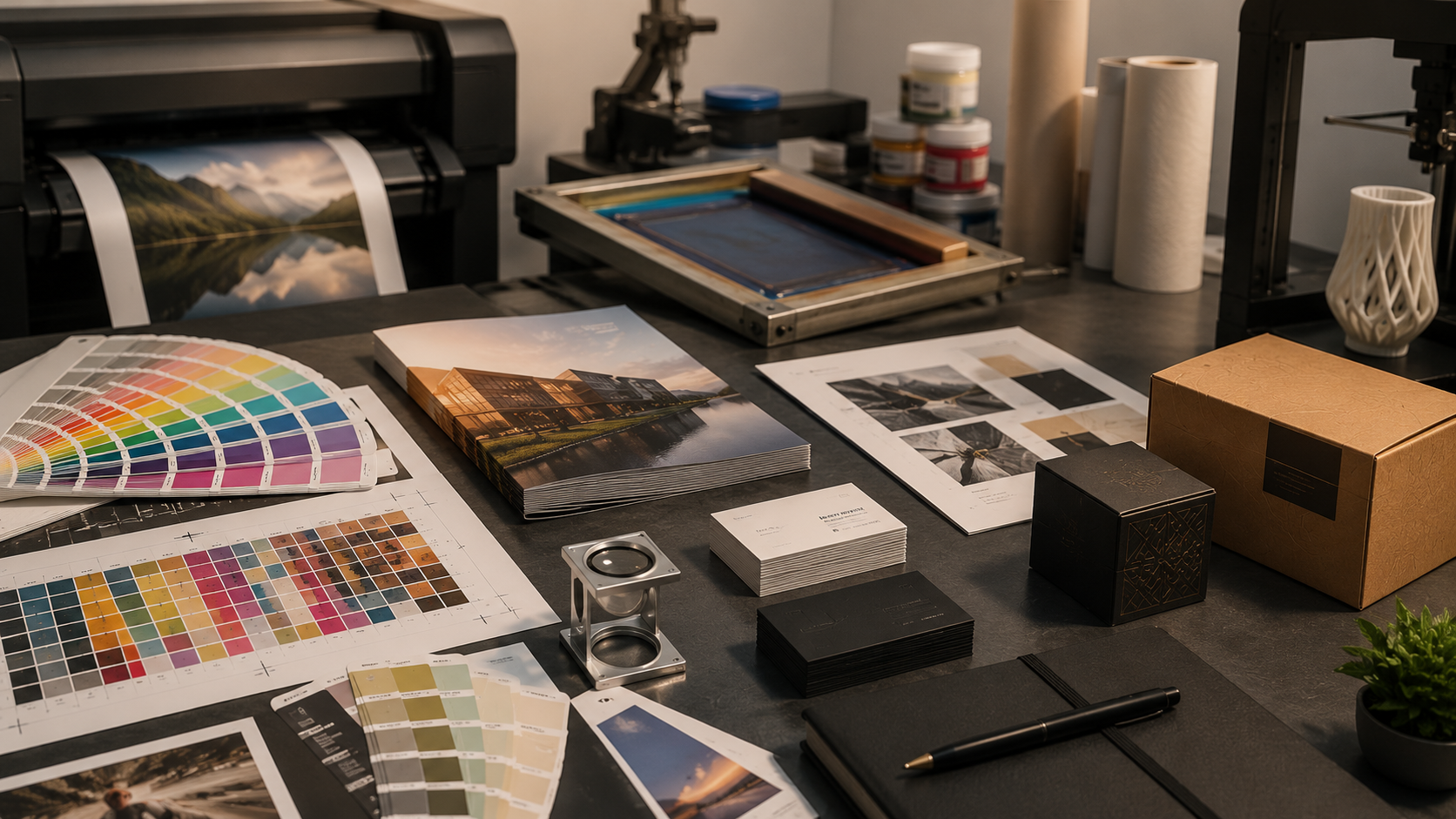
Print Design
More Than Ink on Paper: Why Printing Still Matters in a Digital World
In an age of screens, notifications and endless scrolling, it is easy to assume printing is a relic of the past. Yet businesses, artists and everyday consumers still rely on print every day — from business cards and packaging to fine-art reproductions.
Printing creates tangible, trusted and memorable experiences that screens cannot replicate. It remains essential for packaging, publishing, signage, product labeling, branding and physical communication.
Printing has not disappeared; it has evolved into a highly technical, design-critical craft that bridges the digital and physical worlds.
What Printing Actually Involves
Printing is the process of reproducing text and images onto a physical surface — most commonly paper, but also fabric, plastic, metal and countless other materials. What looks like a simple button press is actually the final step of a much longer pipeline involving color calibration, material selection, resolution settings and finishing techniques.
Getting a great print result means understanding how digital design translates into a physical object — and that translation is where most amateur print jobs go wrong.
The Main Types of Printing
Offset Printing
The industry standard for high-volume jobs such as magazines, newspapers and packaging. Offset printing transfers ink from a plate to a rubber blanket and then onto the print surface. It delivers exceptional color consistency and sharpness, making it a strong choice for large print runs where cost per unit matters.
Digital Printing
Ideal for smaller runs, digital printing sends files directly to the printer without the need for plates. This makes it faster and more cost-effective for short runs, personalized print jobs and quick turnarounds, though it can be less economical at very high volumes.
Screen Printing
Common in apparel and merchandise, screen printing pushes ink through a mesh stencil onto the surface. It is valued for vibrant, opaque color and durability, especially on fabric, but is less suited to fine detail or full-color photographic images.
3D Printing
Though conceptually different from traditional printing, 3D printing builds physical objects layer by layer from digital models. It is used across prototyping, manufacturing, healthcare and architecture.
Large-Format Printing
Used for banners, posters, vehicle wraps and signage, large-format printing requires designs to be built with different resolution and viewing-distance considerations than something intended to be held in the hand.
Key Concepts Every Designer Should Know Before Sending a File to Print
Color Modes: CMYK vs RGB
Screens display color using RGB light, while printers use CMYK ink. A design that looks vibrant on screen can look dull or shifted when printed if it is not prepared properly for the intended print process.
Resolution and DPI
Print generally requires much higher image resolution than screens — commonly 300 pixels per inch at final size for many close-viewed materials. A logo or photograph that appears crisp online can look grainy in a brochure if the source file is too small.
Bleed and Trim
Because cutting a printed sheet to its final size is never perfectly precise, designers add bleed — extra artwork extending beyond the intended edge — so no unwanted white sliver appears after trimming.
Paper Stock and Finish
The choice of paper, including its weight, texture and finish, dramatically changes how a design feels and reads. A glossy finish can intensify color and feel modern, while matte or uncoated stock can feel tactile, understated and premium.
Why Print Still Matters in a Digital-First World
- Tangibility builds trust. A well-designed business card, packaging box or printed portfolio creates a physical impression that a screen cannot replicate.
- Print cuts through digital fatigue. With inboxes and feeds oversaturated, a beautifully printed mailer or brochure can stand out because it is not another notification competing for attention.
- Branding depends on consistency across media. Packaging, signage, merchandise and printed collateral reinforce recognition in the physical world.
- Certain industries depend on print. Publishing, packaging, product labeling and large-scale signage remain fundamentally print-based industries.
Common Mistakes That Ruin a Print Job
- Designing without accounting for the intended print color process, leading to unexpected or shifted colors.
- Using low-resolution images pulled from the web, resulting in blurry or pixelated prints.
- Ignoring bleed, trim and safe margins, causing important text or images to be cut off.
- Choosing the wrong paper stock for the project’s purpose, such as glossy paper for a document intended to be written on.
- Skipping a physical proof before a full print run and missing color or layout issues that only appear on paper.
The Future of Printing
Printing continues to evolve alongside technology. Important innovations include:
- Variable-data printing: allowing every printed piece, from direct mail to packaging, to be personalized at scale.
- Sustainable printing practices: including lower-impact inks, recycled stocks and reduced-waste production methods.
- On-demand printing: producing exactly what is needed when it is needed instead of relying on large speculative runs.
- Advanced 3D and industrial printing: expanding printing from flat surfaces to fully manufactured objects.
Final Thoughts
Printing may not dominate headlines the way digital technology does, but it remains a vital, tactile extension of design and branding. It demands a different kind of precision than screen design — one rooted in physical materials, color science and craftsmanship.
Whether it is a single business card or a nationwide packaging rollout, understanding the fundamentals of printing helps ensure that what looks great on a screen translates into something equally powerful in someone’s hands.